If you have solar panels, you know the feeling: on sunny days you often produce more power than you can consume at that moment. Today, that surplus usually flows back into the grid — and the compensation you receive for it is minimal. A pity, really, because it’s energy you generated yourself.
With the rise of bidirectional charging, that story changes completely. Thanks to this smart technology, your electric vehicle becomes an energy storage system, allowing you to store excess solar power and reuse it whenever you need it. No more lost sunshine, and maximum return on your solar investment.
In this blog, we explain how it works, the benefits, and why this will become a gamechanger for homeowners with solar panels and an electric car.
What exactly is bidirectional charging?
With a traditional charger, electricity flows in one direction only: from the grid or your solar panels → into your car’s battery.
With bidirectional charging, the process works both ways. Your EV can:
-
power your home
(Vehicle-to-Home or V2H) -
return energy to the grid
(Vehicle-to-Grid or V2G) -
power devices directly from the car
(Vehicle-to-Load or V2L, perfect for camping, emergencies, or tools)
Your electric vehicle essentially becomes a large, mobile home battery.
For many households, this is incredibly interesting: the battery of a standard EV is often 5 to 10 times bigger than a traditional home battery.
Why is this so valuable for households with solar panels?
When your solar panels produce more energy than you’re using at that moment, you currently have three options:
- consume it immediately
- store it in a home battery
- send it back to the grid (for a low fee)
Bidirectional charging adds a fourth — and far more profitable — option:
👉 store your excess solar energy in the battery of your car
This comes with several benefits:
1. You use every kWh you produce
Instead of giving away your surplus for a tiny return, you use it later in the day or at night, when your consumption is higher.
2. You significantly increase your self-consumption
Because of the large capacity of an EV battery, you can store much more solar energy compared to a small home battery.
3. You reduce expensive grid consumption
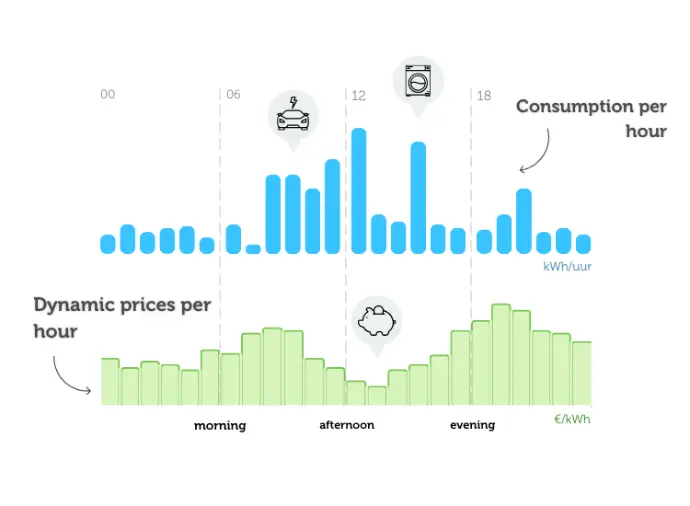
During peak moments, you rely on the stored solar energy in your EV. And with a dynamic tariff, you can even charge when prices are low or negative, and use that energy later.
4. Smart energy instead of wasted energy
Solar power that used to be lost now becomes part of your own energy budget.
100% circular, 100% smart.
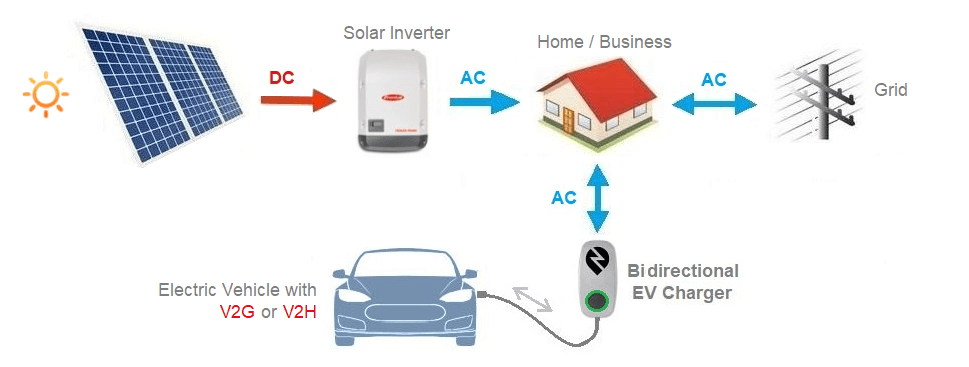
How does a bidirectional system work at home?
It’s simpler than it sounds:
- Your solar panels generate power.
- Your smart charger detects how much energy you’re not using at that moment.
- That surplus automatically flows into your car.
- Later, the charger can send power from your car back into your home.
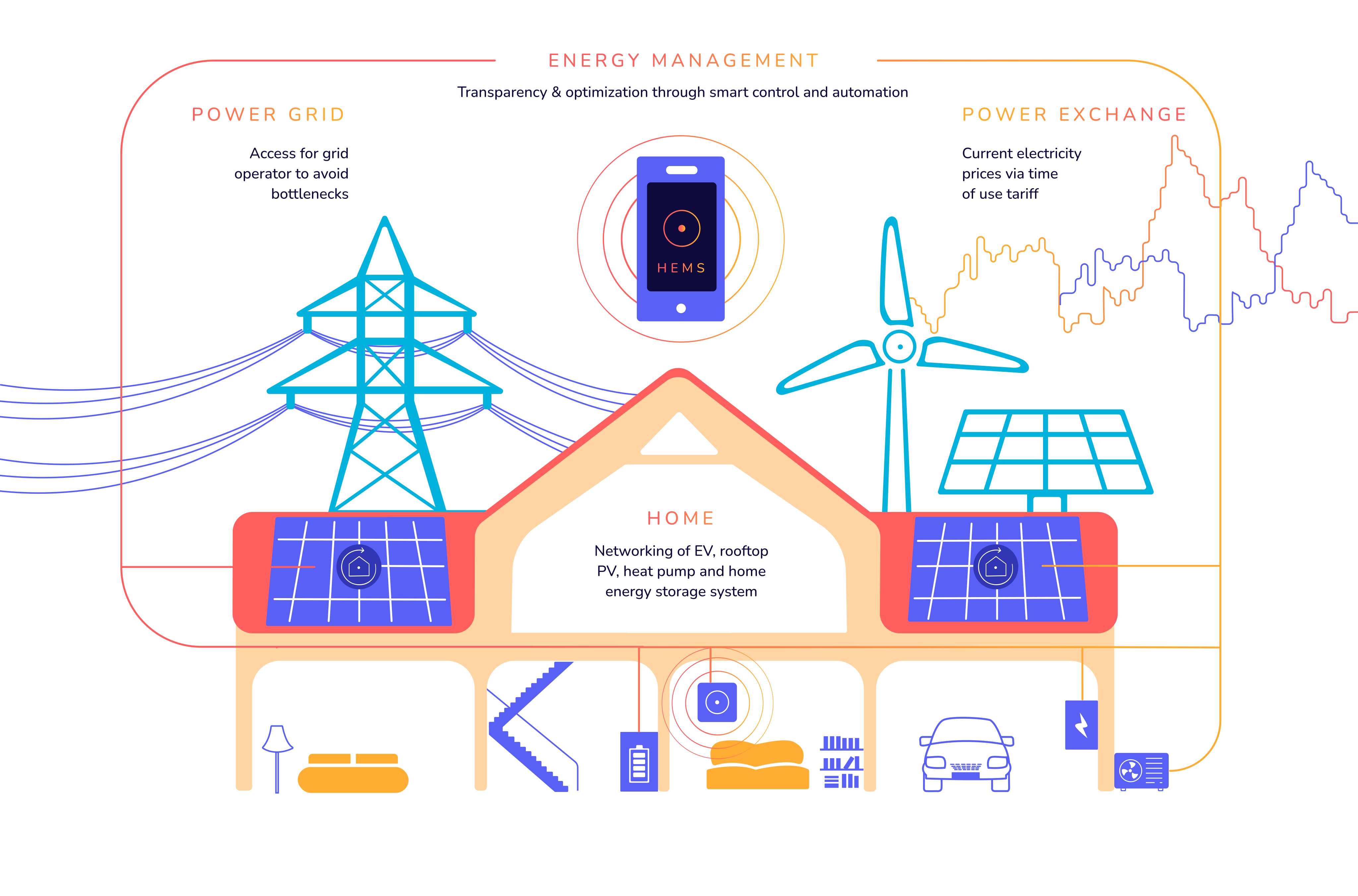
Most of this happens automatically. A smart energy manager controls the entire flow:
- charging when there is solar surplus
- discharging when your home needs energy
- optimising based on grid prices and time-of-use
The result? A self-sufficient, efficient and cost-saving energy cycle inside your home.
Where do we stand today?
Bidirectional charging is accelerating fast:
-
More and more vehicles support V2H and V2G
(Hyundai, Kia, Ford, Volvo, Nissan, VW models and others) - Grid operators are preparing regulations and standards
- Smart chargers are becoming more accessible
- The combination of solar + EV storage is gaining momentum everywhere
Experts expect 2025–2030 to be the tipping point where bidirectional charging becomes mainstream, just as solar panels became a decade ago.
Is bidirectional charging cost-effective? Absolutely.
You save money on three levels:
1. Higher use of your own (free) solar energy
The more you consume yourself, the less you must send back to the grid at a low rate.
2. Reduced purchase of expensive peak energy
In the evening or during high-consumption moments, you rely on your EV battery.
3. Faster return on investment
Solar panels + a smart charger + EV storage = an ultra-efficient system that optimises your energy flow. For many households, this can save hundreds of euros per year.
Are there limitations?
Yes, although mostly temporary:
- Your vehicle must support bidirectional charging
- You need a compatible bidirectional charger
- V2G regulation is still evolving
- Smart energy management is essential for maximum benefit
But: the technology is here, the infrastructure is emerging, and car manufacturers are rapidly adopting it.
Why bidirectional charging is the future
Because it makes your energy:
- greener (you use what you produce)
- cheaper (less peak consumption and grid dependency)
- smarter (automated energy optimisation)
- more efficient (no solar energy wasted)
With an electric car, you can do far more than drive. It becomes an energy source, a buffer, a home battery, and part of your daily energy ecosystem.
Conclusion
Bidirectional charging transforms the way we think about energy. Your car becomes an active part of your household, not just a consumer, but an energy partner.
For families with solar panels, this is the smartest way to:
- avoid losing self-produced clean energy
- lower energy costs
- live more sustainably
- prepare your home for the energy future
The sun is free. And now, you decide what happens with every ray of it.